
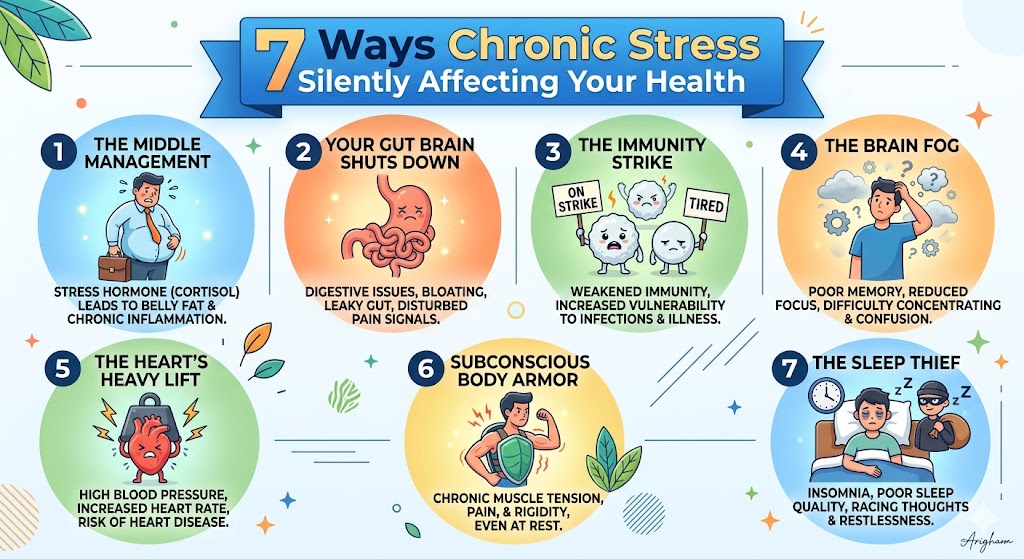
seven silent ways chronic stress is affecting you and how to start listening to your body again.
1. The “Middle” Management
When you experience stress, your body releases a hormone called cortisol. Its job is to give you a quick burst of energy to survive. However, when stress never turns off, cortisol tells your body to store fat, specifically around your midsection, to save up for a rainy day.
- The Reality: You can’t out-exercise a body that is stuck in stress induced “survival mode.”
2. Your Gut “Brain” Shuts Down
Have you ever lost your appetite or felt “tied in knots” during a tough week? Your gut and brain are in constant communication. Under stress, your body pulls blood away from your digestive system to power your muscles for a “fight.”
- The Result: This leads to bloating, indigestion, and an imbalance in your gut health because stress changed your digestive priority.
3. The Immunity “Strike”
Stress is an expert at distracting your immune system. When your brain is occupied with stress, it stops investing in your internal defense team.
The Pattern: This is why you might catch every cold going around or feel “run down” the second you finally take a break from the stress of work.
4. The Brain Fog
Chronic stress can actually shrink the parts of your brain responsible for memory and focus. Meanwhile, the “fear center” of your brain gets bigger and more reactive because of constant stress triggers.
- The Feeling: If you feel like you can’t remember where you put your keys, it’s not you—it’s just a brain overloaded by stress.
5. The Heart’s Heavy Lift
You can’t see high blood pressure, but your heart certainly feels the stress. It makes your heart beat faster and your blood vessels narrow. Over time, this constant stress puts a lot of wear and tear on your cardiovascular system.
- The Lesson: Taking a deep breath is a physical requirement to protect your heart from stress.
6. Subconscious “Body Armor”
Take a second right now: are your shoulders near your ears? Is your jaw clenched? We do this subconsciously to protect ourselves when we feel stress.
- The Impact: This “armoring” leads to tension headaches and back pains that won’t go away until the underlying stress is addressed.
7. The Sleep Thief
Stress loves to keep you “wired and tired.” It flips your internal clock, keeping your energy high at night when it should be low.
- The Cycle: You might fall asleep from exhaustion, but stress prevents you from reaching the deep sleep your brain needs to reset for tomorrow.
How to Start Mentoring Your Stress

Healing doesn’t require a total life overhaul. It starts with small, human moments of stillness to counter the stress.
- Breathe Like a Child: Deep, belly breaths signal to your nervous system that the stress is over.
- Soft Hands, Soft Jaw: Periodically check in and physically “drop” the stress you’re holding in your muscles.
- Nature’s Medicine: Five minutes of looking at trees can lower stress levels faster than almost anything else.
- One Thing at a Time: Multitasking is just stress in disguise. Try to do one task with your full presence.
Here are the most effective, science-backed ways to lower your stress load and start feeling like yourself again: Blog
1. Prioritize “Active” Recovery
Rest isn’t just lying on the couch scrolling through your phone, that often keeps your brain in a state of high-alert. Active recovery means doing things that physically signal safety to your brain.
- The Vagus Nerve Hack: Gently splashing cold water on your face or humming a low tune can stimulate the vagal nerve, which acts as the “brake pedal” for your stress response.
- Movement for Release: Try shaking or dancing for two minutes. Animals in the wild literally shake after a stressful event to release the stored energy. It works for humans, too.
2. Rebuild Your Nutrient Buffer
Chronic stress burns through your body’s mineral stores like a wildfire. To cure the physical depletion, you need to restock the shelves.
- Magnesium and Vitamin C: These are the first things to go when you’re overwhelmed. Focus on dark leafy greens, citrus fruits, and seeds to help your adrenal glands recover.
- Hydrate for the Brain: Dehydration is a physical stress on the brain that mimics anxiety. Drink water consistently to keep your cognitive “engine” cool.
3. Create a “Boundary Buffer”
Sometimes the cure for stress isn’t a supplement; it’s a boundary. Your environment plays a huge role in how much stress you carry.
- The Digital Sunset: Commit to turning off work notifications by 7:00 PM. Give your mind a “transition zone” between the demands of the world and the peace of your home.
- Saying “No” as Self-Care: Every time you say no to an unnecessary task, you are saying yes to your body’s recovery.
4. Practice “Micro-Mindfulness”
You don’t need to sit on a mountain top for an hour to meditate. The cure for stress can be found in 60-second intervals.
- The 5-4-3-2-1 Technique: When you feel a spike of stress, name 5 things you see, 4 things you can touch, 3 things you hear, 2 things you smell, and 1 thing you can taste. This anchors you in the present moment and pulls you out of a “fear loop.”